The GLP-1 Conversation Women Deserve to Have
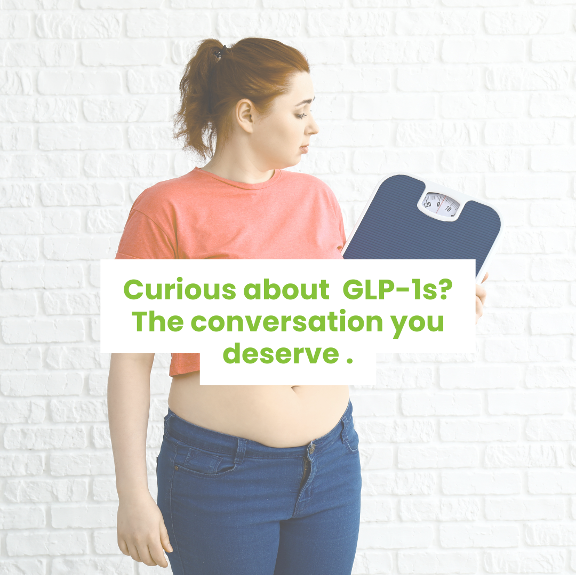
Weight loss may be meaningful and medically valuable for some women.
But the goal should not be to make the body smaller while unintentionally making it weaker, more depleted, or less capable.
Three women can walk into a medical appointment carrying extra pounds—and each will arrive there through a completely different body-story.
One may be struggling with emotional eating after a painful season of life. She may alternate between reaching for comfort foods and then restricting later meals out of guilt. Her cholesterol may have risen again, even though she has previously shown that it responds beautifully when her nourishment, stress, and daily rhythms are supported.
Another may be active, well-nourished, metabolically healthy, and strong, but deeply discouraged about weight gained during perimenopause. She may have spent previous years attaining weight loss through restrictive dieting, intense exercise, and ignoring her body’s signals — only to leave her body now feeling more protective and metabolically less responsive.
A third may have carried extra weight since college. Her mother has type 2 diabetes, her father is being treated for cardiovascular disease, and she is now entering perimenopause with aching knees, less desire to move, and a life that feels stretched between work, teenagers, family demands, and guilt about making time for herself.
All three may be offered a GLP-1 medication.
All three deserve more than the same conversation.
The same recommendation may land very differently for each woman. One may feel hopeful. Another may feel judged. Another may feel torn between trusting her provider and trusting what she wants for her own body.
This is where the GLP-1 conversation becomes about far more than medication. It becomes a conversation about health, shame, authority, and a woman’s right to understand her options, ask questions, and participate fully in decisions about her own body.
An offer is not a judgment
First, if this topic is resonating with you, I’d like you to hear this: your medical provider may recommend a GLP-1 medication because it is one of the tools available and may offer meaningful benefits for appropriately selected patients. But that recommendation does not necessarily mean your provider sees you as lazy, hopeless, or incapable of caring for yourself.
And… it also does not mean the offer will feel emotionally neutral for you. It may sting. It may hit a tender spot. It may make you question your self-worth and abilities.
If so, you would be in good company. Women have lived decades receiving messages that body size reflects attractiveness, health, discipline, and even moral worth. So when weight-loss medication enters the room, it can activate a much deeper fear:
Is my body now a problem that needs to be medicated for life?
Some women feel ashamed that they are quietly considering medication. Others feel ashamed that they do not want it — even though it may make them appear successful with weight loss. Some worry that declining their doctors offer will make them appear uncooperative—or that any future health problem will be blamed on the choice they made.
Naming that shame matters.
Because shame thrives when it remains hidden. And it can quietly influence decisions that should be made instead through education, inquiry, reflection, and self-respect.
You are allowed to pause
It may not occur to you while you’re sitting there in your white, paper robe but being offered a medication does not require an immediate answer.
You are allowed to say:
“I’d like time to think about this.”
“Would you please explain why you believe this is a good fit for me?”
“What outcomes are we hoping to improve besides weight loss?”
“What are the alternatives?”
“What would we monitor if I begin?”
“Could we revisit this in 3-6 months after I address some other factors?”
“What happens if I decide this is not right for me or not the right time for me?”
These are not disrespectful questions. They are signs of an engaged patient.
Your provider brings important expertise in medical appropriateness, contraindications, prescribing, dosing, and monitoring.
And you bring something equally essential:
You are the authority on your lived experience — your body-story.
Only you know what it has taken to live in your body. You know what you value, what you fear, what you have already tried, and what kind of support you realistically have the capacity to engage with right now.
Your voice belongs in the decision.
The same weight does not tell the same story
A GLP-1 receptor agonist medication may reduce appetite and support weight loss. But appetite suppression does not automatically address why a woman is eating—or why her body may be holding on to excess weight.
For one woman, comfort foods may have become a way to soften grief, loneliness, overwhelm, or chronic stress. Quieting her appetite may reduce how much she eats, but it may not resolve the emotional needs beneath the behavior.
For another, weight may have increased during a hormonal transition, chronic nutrient restriction, overtraining with insufficient recovery, toxin accumulation, or prolonged stress. Asking her body to become smaller again—without first considering what it may be adapting to—could add another layer of internal stress.
For a third, a GLP-1 medication may be a very reasonable tool to help reduce cardiometabolic risk, improve mobility, relieve pressure on painful joints, and create enough momentum that movement and self-care begin to feel possible again. But even for her, the prescription should not be the whole plan. She may still need help protecting muscle, improving nourishment, stabilizing blood sugar, building strength safely, addressing sleep and stress, and creating space for care that does not bury her in guilt.
None of these stories can be defined or even understood through weight alone.
The woman is not to blame.
She is actually crucial to the conversation.
WHAT’S MISSING FROM THE GLP-1 CONVERSATION
What is often missing from the GLP-1 conversation is the whole woman.
Not just her weight, appetite, waistline, or lab results. But her body-story, relationships, resources, needs, values, self-respect, stress load, and the season of life she is trying to navigate.
She is not simply a body to make smaller or a set of numbers to improve.
She deserves care that meets her where she is, helps her understand what her body may be responding to, and gives her room to choose a path that supports both her health and her humanity.
This is why I keep returning to a question that is being asked far too quietly:
Why are we talking so much about increasing GLP-1 through medication—and so little about the whole metabolic environment surrounding hunger, fullness, blood sugar, and weight resistance?
That environment often includes:
glucose and insulin regulation
emotional and stress-related eating patterns
protein and total nourishment
personalized supplementation
muscle and strength
sleep and circadian rhythm
digestion and the microbiome
thyroid and sex hormones
inflammation
medication history
years of dieting, restriction, or overexercise
and the meaning a woman has learned to attach to her weight
A medication may still belong in the plan, but it should not erase the rest of the story.
Three places to begin
Before deciding whether a GLP-1 medication may be right for you, right now, consider beginning here:
1. Ask what problem you are hoping it will solve
Is it persistent hunger or food noise? Blood sugar or insulin resistance? Cardiometabolic risk? Physical discomfort or reduced mobility? Breaking old patterns? Or is it the irritation that your body no longer looks the way you believe it should?
There is no shame in an honest answer. But ask yourself until you arrive at the answer, because the answer matters. Why? Because we need to be honest that a medication can only help with the problems it is equipped to address.
2. Ask what may remain unresolved
Could emotional distress still need care? Could undernourishment, constipation, poor sleep, hormonal shifts, low muscle mass, inflammation, or unstable blood sugar still require attention?
Could the medication make “eating less” easier while leaving your relationship with food, your body, or yourself unchanged?
This is not an argument against medication.
It is an invitation to build a plan that is large enough to include the whole woman.
3. Ask what kind of support surrounds the prescription
What will be monitored besides the number on the scale?
Who will help you protect your nutrition needs when your appetite changes or drops?
Who will notice if your digestion, bowel function, energy, or food tolerance begins to change?
What happens when you want to go off the medication?
A prescription may be one part of care, but it realistically can not carry the entire burden of creating health.
The goal is not simply a smaller body
Weight loss may be meaningful and medically valuable for some women.
But the goal should not be to make the body smaller
while unintentionally making it weaker, more depleted, or less capable.
A health-building and health-protective plan should also consider:
nourishment and supplementation
digestion and elimination
muscle mass and strength
sleep, stress, and energy
glucose, insulin, and lipid patterns
emotional well-being
metabolic resilience and thyroid function
and the woman’s relationship with her own body
The scale is one data point. But it is not the whole story, and it is certainly not a measure of a woman’s worth.
My role is not to talk women out of, or into, GLP-1
My role is to help a woman better understand the terrain surrounding her decision.
Together, we may look at:
what could be contributing to her metabolic and weight patterns
whether foundational needs are already being missed
how well she is nourishing and digesting her food
what her bloodwork may reveal about glucose, insulin, inflammation, thyroid function, nutrients, and organ health
how to protect muscle, strength, digestion, and nourishment if appetite decreases
what questions she wants to bring to her prescribing provider
how she can remain connected to her body while some of its familiar signals are changing
She remains the authority on her lived experience.
Her medical provider brings expertise in prescribing, contraindications, dosing, questions, and medical monitoring.
I bring the functional interpretation, pattern recognition, nutrition and lifestyle support, and intuitive coaching needed to help her make choices that are in alignment for her to care for her whole body.
That is the kind of collaborative care New Leaf Holistic Health represents. 💚
The conversation you deserve
You deserve care that does not shame you for wanting medication. You also deserve care that does not pressure you to accept it. You deserve the opportunity to ask questions, understand your options, consider the whole picture, be considered as a whole person, and then decide what feels most aligned with your health, values, and long-term goals.
A GLP-1 medication may be a useful tool for some women. It is a thoughtful decision, not to be made from fear, embarrassment, or the feeling that you have surrendered authority of your own care. Your health deserves to be understood in context.
Because the most important question isn’t simply whether a GLP-1 can help you lose weight.
It is whether your whole care plan is honoring the whole woman and helping you become stronger, better nourished, more metabolically supported, and more capable of sustaining your health for years to come! 💚
This article is for educational purposes only and is not a recommendation to begin, stop, microdose, or change a medication. Medication decisions and dose adjustments should be made with an appropriately qualified prescribing provider.